Jeans hold up to more than most clothing, and a small hole in denim is a somewhat different repair than the same size hole in a lighter shirt fabric — How to Fix a Small Hole in a Shirt covers the general approach, but denim’s thickness, the way jeans take repeated stress at the knee and seat, and how much wear people expect jeans to survive all change a few specific decisions along the way.
Start With an Honest Look
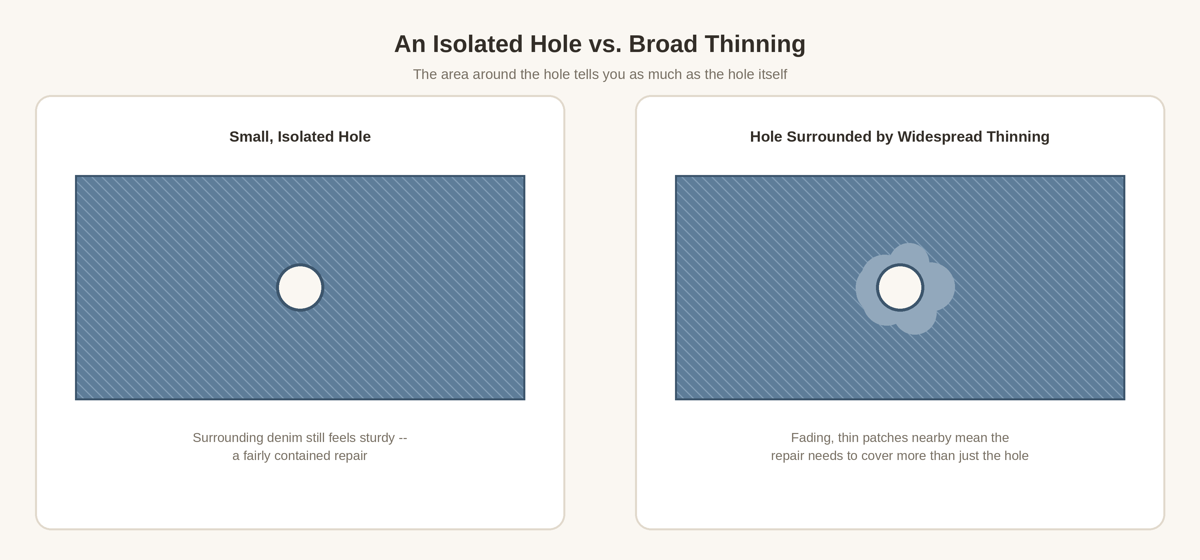
Before doing anything, check a few things: whether this is actually a hole or more of a thinning, worn area that hasn’t fully given way yet; whether the fabric around it is fraying; how that surrounding denim feels compared to denim elsewhere on the jeans; where it is; how much stress that spot takes when you move; whether any fabric is actually missing; and whether the damage seems to still be spreading. A hole surrounded by denim that still feels sturdy is a more contained repair than a hole that’s really just the most visibly failed point in a broader area of thinning — in the second case, the repair needs to account for more than the hole itself.
Where It Is Changes What It Needs
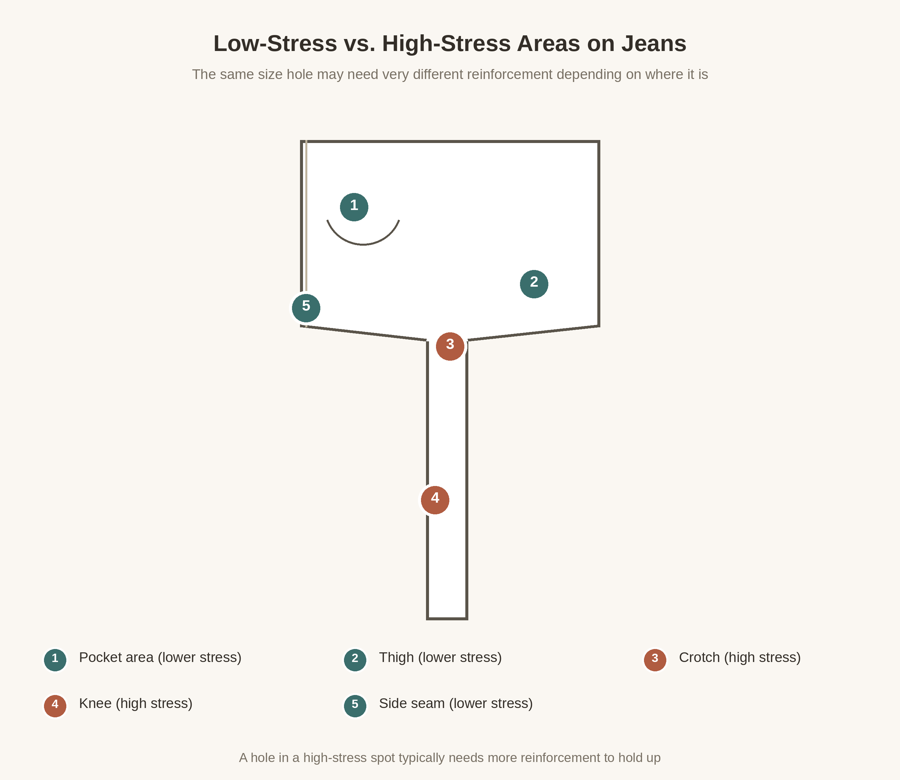
Not every spot on a pair of jeans takes the same kind of wear. The knee bends and flexes constantly. The seat and crotch take stress every time you sit or move, and that area’s construction is often more complex than a flat panel. The pocket area and thigh generally see less repeated stress, and a side seam is a construction line rather than an open expanse of fabric. A method that works fine for a small, low-stress hole in the pocket area may not hold up nearly as well on the knee or the seat, where the same repair gets pulled and flexed constantly. This doesn’t mean a high-stress repair is off the table for a beginner — but a crotch or seat repair, in particular, is worth going into knowing it may take more care, more reinforcement, and realistically may be harder to get right on a first attempt than a straightforward knee or thigh hole.
Choosing an Approach
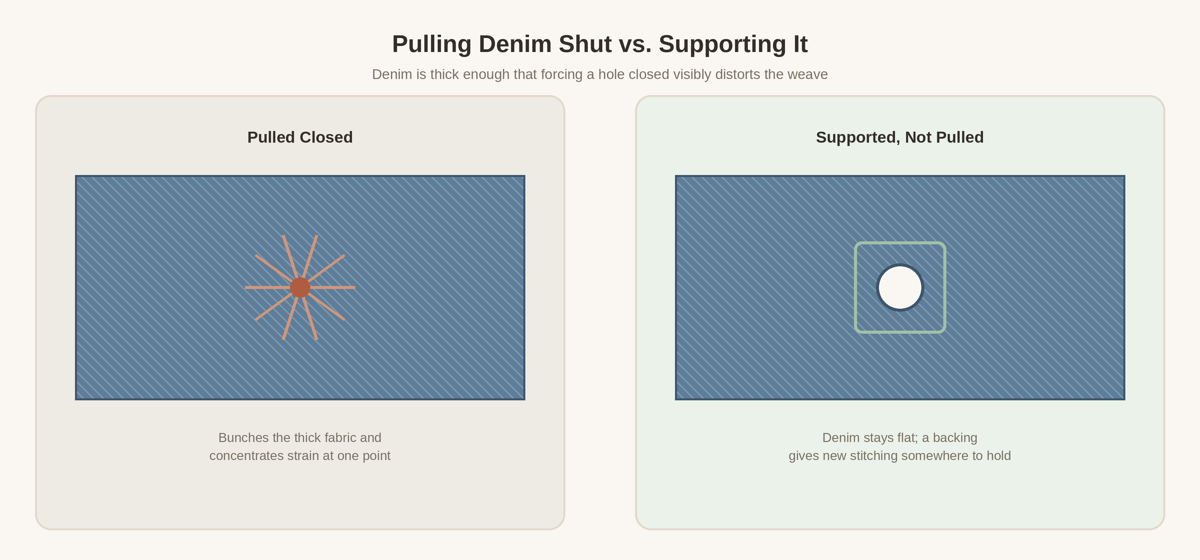
Depending on what you’re looking at, a few approaches are reasonable: reinforcing from the wrong side, adding a patch, hand-stitching to stabilize fraying edges before they get worse, or visible mending if you like that look on denim. None of these is the universally correct choice — a tiny, isolated hole in otherwise solid denim doesn’t need the same intervention as a hole surrounded by fabric that’s visibly thinning across a wider area. As with any hole where fabric is actually missing, avoid simply pulling the edges together and stitching them shut; denim is thick enough that doing this visibly bunches and distorts the fabric rather than closing invisibly.
Reinforcement Should Extend Past the Damage
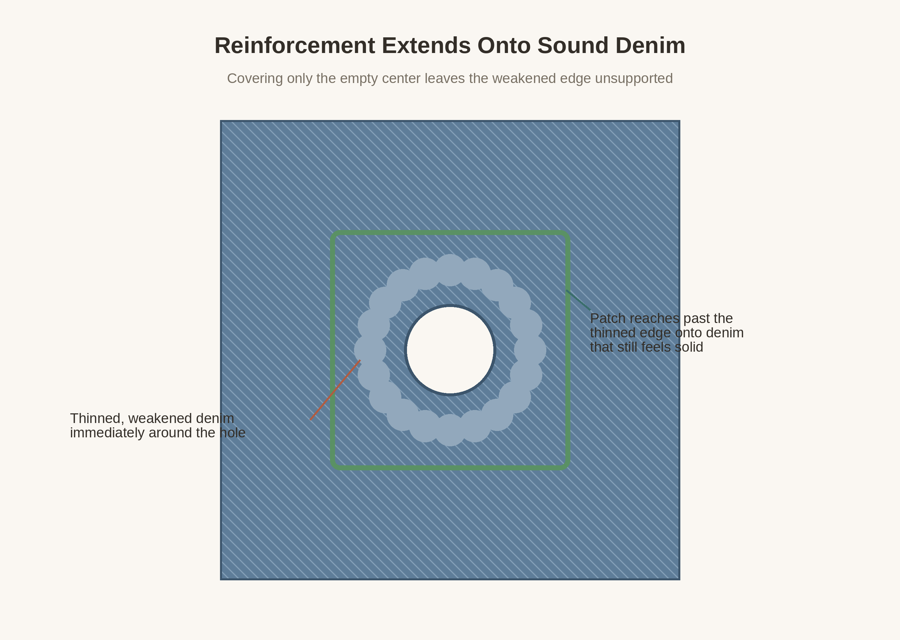
Whatever backing or patch you use, it should reach past the hole itself and onto denim that still feels solid — not just cover the empty center. Fabric immediately around a hole is often already thinned and weakened even where it hasn’t fully given way, so stitching only at the hole’s edge anchors into the weakest part of the fabric. There’s no single correct margin to extend the reinforcement by; it depends on how far the thinning actually extends and how much stress the area takes — a small, isolated hole in a low-stress spot needs less margin than a hole in a heavily worn, high-stress area. Whatever backing material you choose, its weight and flexibility should make sense for the garment: something drastically stiffer than the denim itself can feel uncomfortable and create an obvious ridge, so more flexible or medium-weight reinforcement is often more comfortable than the stiffest option available, even though denim itself is a sturdy fabric.
Needle and Thimble for Thicker Fabric
How to Choose a Sewing Needle for Hand Sewing covers needle selection in general; for denim specifically, the main thing to know is that forcing a needle that’s too fine or too short through multiple layers of heavy denim can be genuinely difficult and risks bending or breaking the needle. There’s no single needle size that’s correct for every pair of jeans — fabric weight and how many layers you’re sewing through both matter. A thimble can help meaningfully here, since pushing a needle through thick denim by hand can take real pressure on a fingertip. That said, if a needle is consistently very hard to push through, that’s usually a sign to reconsider the needle rather than a reason to keep forcing it through with more pressure.
Thread
How to Choose Thread for Clothing Repairs covers matching thread to a repair generally. It’s worth noting that “it’s denim” doesn’t automatically mean you need heavy-duty upholstery thread — the right thread depends on the needle you’re using, the specific repair, how visible you want the stitching to be, and how much bulk is appropriate for that spot. A lighter or medium-weight thread is entirely reasonable for a small, low-stress denim repair.
What the Stitching Actually Needs to Do
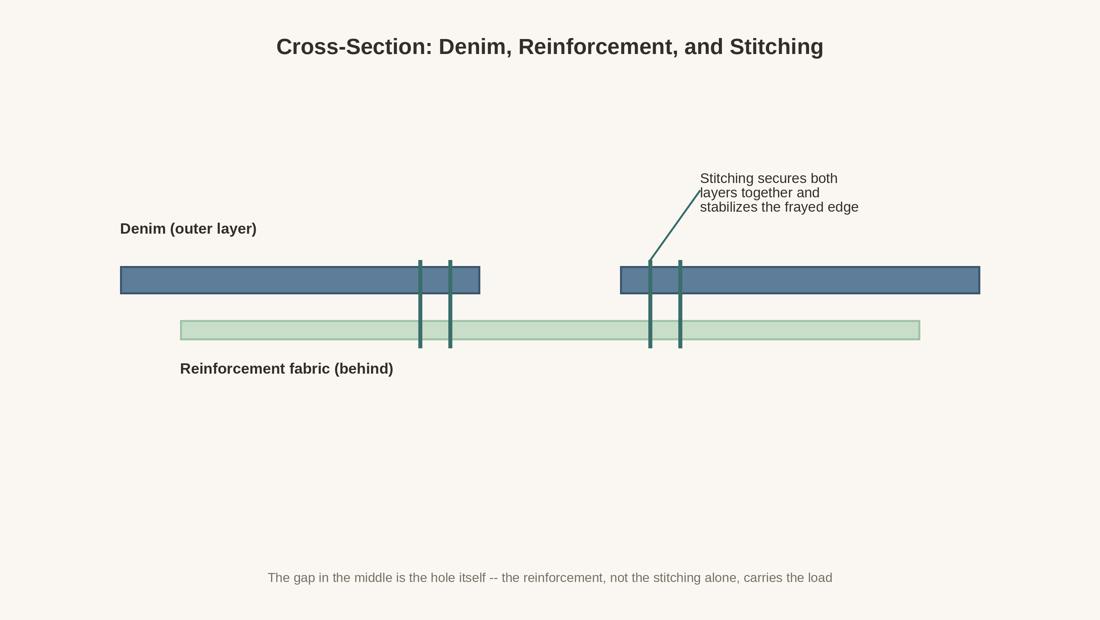
There’s no single stitch that’s universally correct for repairing a hole in jeans — what matters is that the stitching accomplishes three things: it stabilizes the frayed or thinning edges so they stop unraveling further, it secures the reinforcement or patch to the garment, and it distributes stress across the repair rather than concentrating it at one point. Basic Hand Stitches Every Beginner Should Know covers stitch mechanics that apply here as much as anywhere else. And as with any hole repair, it’s worth going in with realistic expectations — a repair on denim can look neat and hold up well, but claiming it will be invisible oversells what stitching through a hole can actually achieve.
Checking the Finished Repair
Before considering it done, check for puckering around the repair, whether the area restricts normal movement when you bend or sit, whether any internal edges feel sharp or unusually stiff against your skin, whether any thread ends are loose, whether the original damage seems to be continuing to spread beyond the repair, and whether there’s obvious new strain concentrated right around the patch. These are the same signs that separate a repair that holds up from one you’ll be redoing soon.
When to Get Help
A small, low-stress hole is a reasonable project for a beginner. A repair involving the crotch or seat, jeans with substantial surrounding wear, or a pair you don’t want to risk getting wrong are all situations where it’s worth being realistic about your own experience level — these repairs aren’t impossible to do at home, but they’re harder to get right on a first attempt, and When Clothing Can Be Repaired and When It Should Be Replaced can help you weigh whether a DIY attempt, a professional repair, or replacement makes the most sense for that particular pair.