Care labels use symbols instead of words for a practical reason — the same tag can travel with a garment across countries and languages. Most modern labels are built around five basic symbol shapes, and once you can recognize the shapes, the marks inside them — a number, a dot, a bar, or an X — tell you the specific instruction. This guide covers those five categories at a general level. It’s not a substitute for the actual label sewn into a specific garment, which remains the best source for that garment; when the two seem to disagree, the label wins.
A Quick Note on Standardization
Laundry-care symbols are more standardized internationally than most sewing techniques are, largely thanks to organizations like GINETEX that maintain shared symbol systems. Even so, exact conventions can vary somewhat by country or market, and manufacturers occasionally add their own notes alongside the standard symbols. This guide describes the widely used symbol logic — shape indicates category, and marks inside refine the instruction — rather than claiming one single worldwide standard covers every label you’ll ever see. If a symbol on a specific garment looks unfamiliar or doesn’t match what’s described here, treating that label’s own wording (many still include a few words of text) as the more reliable source is the safer approach.
The 5 Basic Symbol Categories
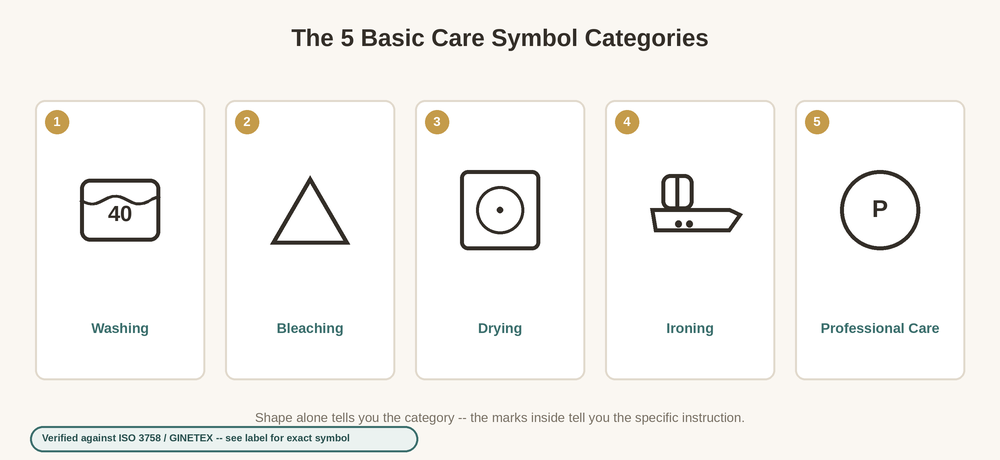
Before looking at what’s inside each symbol, it helps to recognize the five outer shapes on sight, since the shape alone already tells you which kind of instruction you’re looking at:
- A tub — washing
- A triangle — bleaching
- A square — drying
- An iron — ironing
- A circle — professional care
From here, each section below looks at what the marks inside that shape typically change.
Washing Symbol
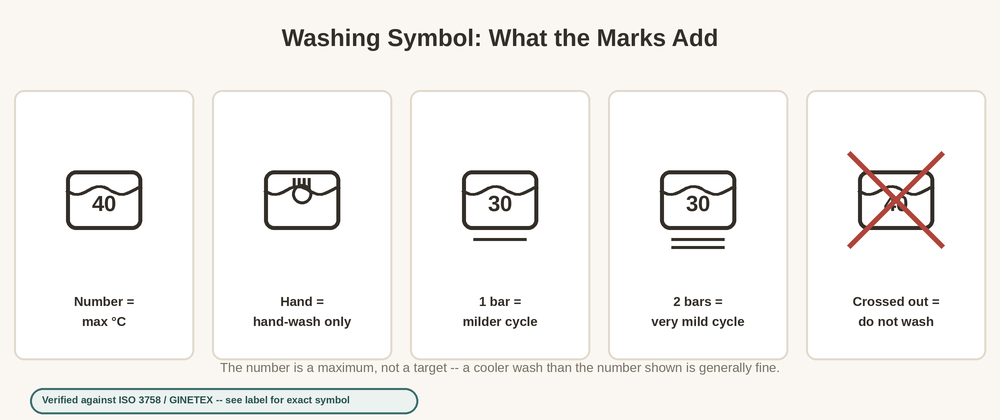
A number inside the tub typically represents a maximum washing temperature in degrees Celsius — it’s a ceiling, not a target, so washing cooler than the number shown is generally fine. A hand drawn over the tub instead of a number typically means hand-wash only, without a machine. A bar underneath the tub generally calls for a milder process, such as reduced agitation; two bars usually call for an even gentler cycle, often used for delicate items. A tub with an X through it means don’t wash the item at all, by machine or by hand.
Bleaching Symbol
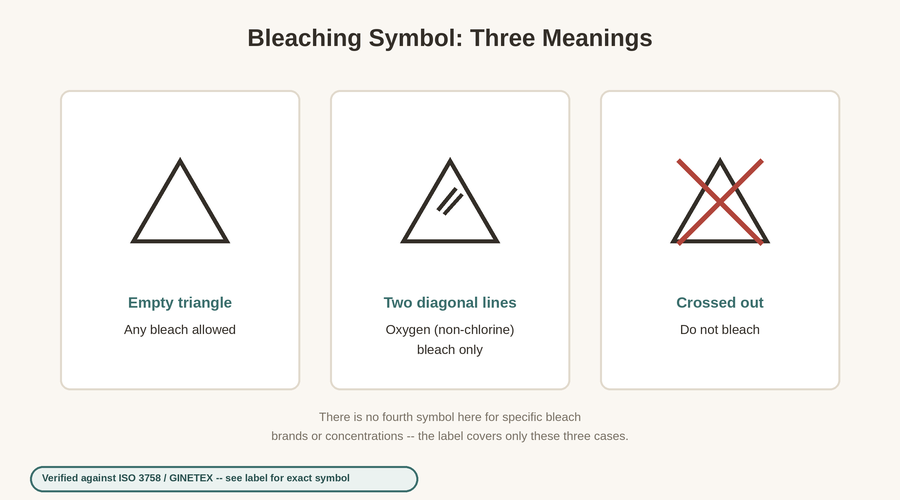
The triangle covers exactly three cases. An empty triangle generally means any bleach is allowed. A triangle with two diagonal lines inside typically restricts that to oxygen-based, non-chlorine bleach only — a meaningfully different instruction from the empty triangle, since chlorine bleach can damage certain fabrics and colors that a milder oxygen bleach wouldn’t. A triangle with an X through it means don’t bleach at all. This guide doesn’t attempt to recommend specific bleach products or concentrations — the symbol tells you which category is allowed, not which brand to reach for.
Drying Symbol
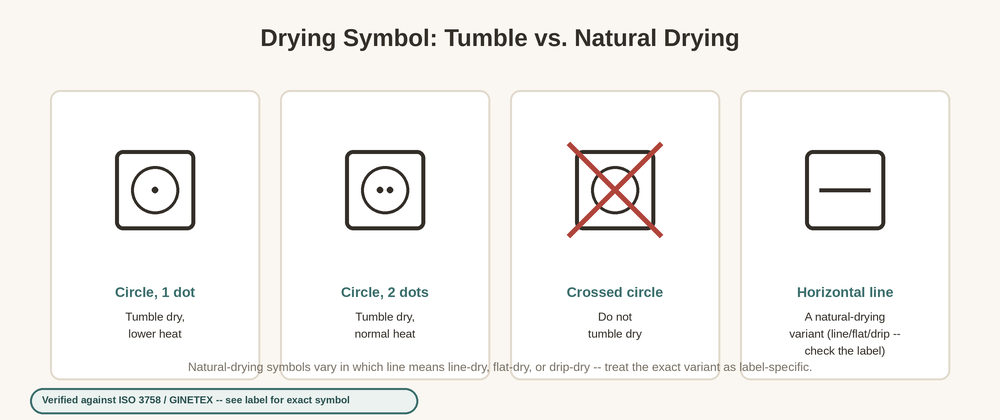
A square with a circle inside generally refers to tumble drying, and dots inside that circle typically indicate relative heat — more dots generally mean a higher heat tolerance, fewer dots a lower one. A square with a circle and an X through it means don’t tumble dry. A square with a line (or lines) instead of a circle typically points to a natural-drying method — hanging on a line, laying flat, or drip-drying without wringing — but exactly which line position maps to which of those methods can vary somewhat between labels, so this is a case worth checking against the specific garment’s tag rather than assuming a fixed universal pattern.
Ironing Symbol
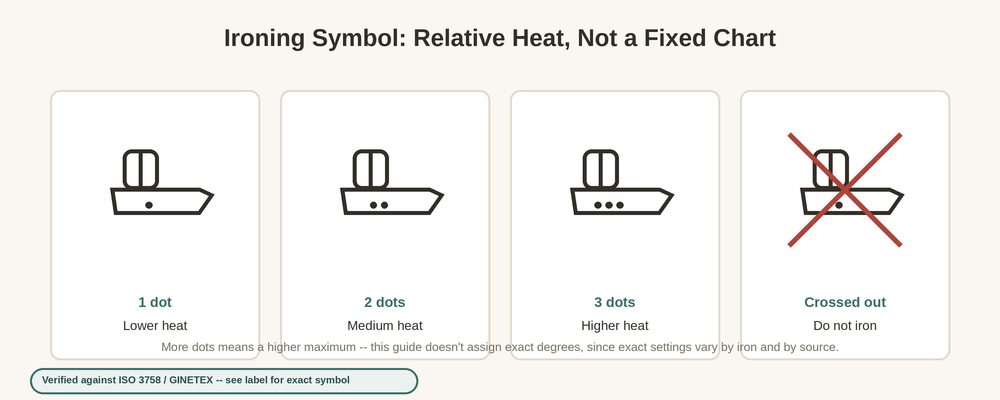
The iron symbol uses dots the same way the drying symbol does — more dots generally indicate a higher maximum heat setting, fewer dots a lower one. This guide intentionally doesn’t attach a specific temperature or fabric type to each dot count, since published figures vary somewhat by source and an iron’s own dial doesn’t always map cleanly onto the symbol’s scale. Treating one dot as “start low” and three dots as “more heat tolerance” is a reasonably safe general reading; if you need a precise setting for a specific fabric, the iron’s own manual or the garment’s specific label is a better source than a general rule. A crossed-out iron means don’t iron the item at all — sometimes because the fabric itself can be damaged by heat, sometimes because of trims, coatings, or prints that heat would affect.
Professional Care Symbol
A circle generally signals that professional cleaning is recommended or required, rather than home laundering. Inside that circle, letters typically indicate which solvents or processes a professional cleaner should use — these letters are aimed at the cleaner, not the consumer, and aren’t meant to be decoded and acted on at home. A bar underneath the circle generally calls for a gentler professional process, similar to how a bar works under the washing symbol. A circle with an X through it means the item shouldn’t be professionally cleaned by that method at all. This guide doesn’t attempt to turn that into a dry-cleaning how-to — if a label points you toward professional care, taking the garment to a cleaner and letting them read the label directly is the more reliable path than guessing at what the letters mean.
When Written Instructions Appear Instead
Some care labels use written phrases — “machine wash cold,” “do not tumble dry,” “dry clean only” — either instead of symbols or alongside them. These written instructions are specific to that label and that garment; they’re examples of the same underlying categories covered above, not a universal phrasebook that applies to every other garment you own. Two shirts that both say “machine wash cold” are each telling you about themselves, not establishing a general rule for shirts in general.
When a Label Is Missing or Unreadable
Labels do fade, get cut out, or go missing over time. When that happens, guessing at the original instruction isn’t a great substitute for the label itself. A more cautious approach — a cooler wash, air drying instead of the tumble dryer, skipping bleach, testing an inconspicuous area before ironing — reduces the chance of damaging something you can no longer check. For a specific concern about a specific garment, the manufacturer’s website, the retailer, or a professional cleaner familiar with the fabric type can sometimes offer more certainty than reconstructing a label from memory.
A Simple Workflow for Reading a Label
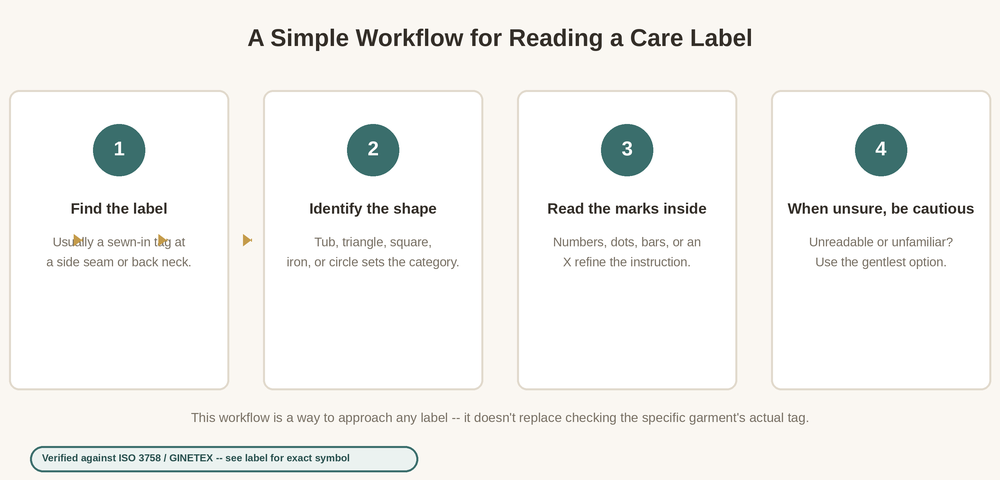
Put together, reading a label doesn’t require memorizing every possible symbol combination — it’s more about recognizing the pattern: find the label, identify the shape to know the category, read the marks inside for the specific instruction, and default to caution when something is unreadable or unfamiliar. That pattern holds up across most labels you’ll come across, even the ones with a symbol combination this guide didn’t specifically cover. Reading the label is really just the first step — How to Make Clothes Last Longer: Everyday Habits That Prevent Damage covers how that fits into the broader set of everyday habits that help clothes hold up over time.